Thursday, September 30, 2010

Hinduism - Connecting to the Gospel of Jesus #5

The goal for a Christian when witnessing for Christ’s love is to present Christ and his work.  

Starting with the Hindu belief of Karma, the cosmic, moral law of the universe which dictates which direction a person will be reborn after their death, a Christian can share that Christianity also teaches a law that governs the universe, and in fact Christians believe that this law is written on the hearts of all men!  (Romans 1:12-16)  However, the punishment for breaking this law is far worse than the punishment of being born outside the caste system, like the punishment the untouchables have for having bad karma from their previous lives (watch the video in the last blog post).  The punishment for breaking the law of God in Christianity is eternal damnation, separation from God.  And the kicker with Christianity is that all of us have broken this law!  No one is righteous!  (Romans 3:10-18)

Christianity has an even tougher road than Hinduism in that we only get one life on earth.  We only have one life to be found “good” in God’s sight.  And the path to connect with God is through his law, which again is so difficult that none of us can meet its standard.  

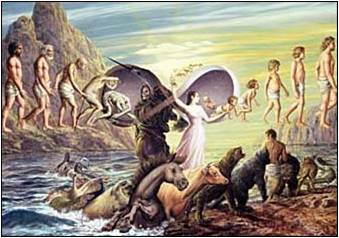
Just as in Hinduism, where people are born again through reincarnation, in Christianity there is a way to be born again too!  This birth doesn’t occur at the death of our physical bodies as it does in Hinduism.  In Christianity, we can be born again spiritually, and this happens just once.  Because we have broken God’s law, we are all spiritually dead, until we are born again through having faith in Christ and his work of salvation for us.  

Being “born again” in Christianity is similar to Moksha in Hinduism.  In Moksha, Hindus believe that a person is liberated, set free, from having to follow the law of karma, escaping once and for all the cycle of death, and rebirth in this world, known as samsara, the circle of life.  For Christians, liberation from the law doesn’t come from our following, or obeying God’s law.  It comes from trusting in Christ.  Christ is the incarnation of God.  Colossians 3:15 says, “He [Jesus] is the image of the invisible God, the firstborn over all creation.”  Hindus should understand this concept of God taking on flesh, because the Hindu god Vishnu is known to have taken on numerous incarnations in the past, the most popular ones being Krishna and Rama (Watch the video in the blog post entitled, “Hindu Influence in Western Culture #1).  Jesus, taking on flesh, being incarnate, was then able to fulfill the law of God since he fully retained his divinity, yet he was able to fulfill it as a human as well, since he also fully took on a human nature.  

Being a perfect in his obedience to the law, Jesus did not deserve the penalty of death.  He was innocent in accordance with the law of God.  However, Jesus served as a substitute for all of humanity, being an atoning sacrifice for us.  He took the death that we deserve for breaking God’s law in his crucifixion on the cross.  Because of his divine nature, being outside of time, Christ was able to suffer death eternally on the cross, paying, on our behalf, the penalty we deserve.  Because he was divine, and because of his obedience, God the Father saw to it to raise Jesus back to live.  The good news is that when we trust in Christ to be our substitutionary sacrifice, we are seen innocent in accord with God’s law and Christ is seen guilty.  We then are liberated from the penalty of breaking God’s law.  We will die a temporary physical death with these bodies, but be raised to live physically in the end of the age.  

There’s never certainty in Hinduism, about how well a person is following the law of karma.  Liberation from karma and samsara lies solely on the individual.  

There’s certainty in Christianity that no one can fulfill the law of God except God.  Liberation from the law of God on written on the hearts of all men is certain in trusting in the work, life, death, and resurrection of Jesus Christ.  

One is a religion of work and uncertainty, grounded in obscure sacred texts with unknown origins.  

One is a religion of grace and certainty, grounded in a historically reliable account of the person of Jesus Christ. 

Tuesday, September 28, 2010

The Untouchables in Indian Hinduism

Hindus believe in reincarnation, called samsara.  They also believe in karma, the cosmic moral law which directs the direction of people's rebirth.  If a person has good karma, he or she will be reincarnated into a higher caste.  Bad karma, a lower caste.

There are four castes for humans.  The first caste belongs to the Hindu priests, called Brahmins.  The caste below the Brahmins belongs to the landowners, the aristocrats, who many years ago when landowners still fought on the battlefield, they were known as the warrior caste.  Below them is the caste for skilled workers.  Below the skilled workers, the unskilled workers.  There is another group of humans, who are not even considered to be a part of the caste system.  They are in fact below the caste system.  Animals are above them!  They are the untouchables.

I know that I said that I would make a connection from samsara, karma, and moksha (the liberation from samsara and karma) with the law of God and the Gospel of Christ.  Before I do this, however, I'd like to share the following video from Youtube.  I think it is truly eye-opening as to how many people are forced to live in the caste system, which still exists today in large parts of India.

If you are a Christian, I'd suggest that you pray for the Untouchables.  Some who watch this video might be led to reach out in other ways to these people besides just prayer.  Prayer is a mighty awesome power and miracles happen through the prayers of Christian believers. By the way, after I am finished writing about Hinduism in contrast to the truth of the Gospel of Christ, I will do my best to address questions about miracles.

Monday, September 27, 2010

Hinduism - Connecting to the Gospel of Jesus #4

The last “connecting” blog post dealt with some key tenants of Hinduism: Brahman, Atman, Maya, Samsara, Karma, and Moksha.  

At first glance, it might be difficult to envision how a connection from these Hindu concepts can be made, but it can be done.  I’d like to be adamant that these connections, in no way mean that Christianity and Hinduism have the same teachings.  That is far from the truth.  All I am doing is pointing out similarities, which can then open the door for presenting the Gospel of Jesus Christ.  

For example, it’s very easy to say, “Oh, Christians hold a similar belief.  We believe the same thing concerning ___________, but we don’t believe ___________.  Instead, the Bible teaches _________.”  

Hindu Teaching:

Brahman – Brahman is the divine essence that is at the heart of all things in the universe.  This teaching ultimately says that there is only one divine reality and that we are all united in it, in fact we consist of it. 


Christian teaching:

Acts 17:28 In this verse, Paul is recorded as having said, “For in him we live and move and have our being.’ As some of your own poets have said, “We are his offspring.”  

Connecting to the Gospel of Jesus
 
Christians hold a similar view as Brahman in that we believe that it is from God that we live and move and have are being.  Colossians 1:17 even teaches that Jesus holds all things together.  However at the heart of each and every one of us, Christians disagree with the Hindu understanding that all is divine.  Christians however recognize that all things in the universe have come from God, but that all things do not consist of God, because God created the universe out of nothing by speaking it into existence.  This however does not mean that we believe God is far off from us.  Paraphrasing what Paul shared in Acts 17, God is still at the heart of all our lives; we have our being because of him, and he determined the times set for us and the exact places that we should live.  In this way, Christians agree with Hindus that God is at the heart of all things, but we certainly would not say that all things are God.  


This still has not made a connection to the Gospel of Jesus Christ.  The connection to the Gospel will come in the next blog post by connecting Karma, the cosmic law of the universe in Hinduism, with the Law of God, and Moksha, the liberation from Samsara, with the pardon from the penalty of breaking God’s Law found in the Gospel of Christ. 

Saturday, September 25, 2010

Hindu Influence in Western Culture #1

I think it's good for Christians to be aware of the many religious influences in Western Culture which are not Christian.  It's good for us to to know these influences so we don't accidentally glorify or lift up false religions.  It's also good for us to know to use as a starting point of conversation with friends when a religiously influenced song or movie is playing.  It's simple to say, "Hey did you know that this song is talking about ______."  It would then be a good opportunity to explain why Christians disagree with that belief and segue into what the Bible teaches on the issue. 

I've been writing about Hinduism lately, while trying to make connections from  those Hindu beliefs and practices to presenting the Gospel of Christ, using Hinduism as a starting point to springboard to a presentation of who Jesus is and what Jesus has done for us.  While I write these blog posts, I'll also intermingle them with examples of how Hinduism has had influence in Western culture.

One aspect of how Hinduism has influenced the West is through the Beetles!  The Beetles introduced Hindu instruments, such as the sitar, to the West.  Influence of Hinduism can be clearly seen in George Harrison's song, "My Sweet Lord."  The song initially sounds like it could be a Christian or Jewish song, singing about wanting to see, touch, and know the Lord, with "Hallelujah" being sung in the background.  Later in the song, a shift is made to the background singers chanting, "Hare Krishna, Hare Krishna, Krishna Krishna, Hare, Hare, Hare Rama, Hare Rama" and etc.  Krishna and Rama are both incarnations of the Hindu god Vishnu.  Krishna is the most known incarnation of Vishnu.  He is the central figure in the Hindu epic, the Bhagavad Gita, and in this epic he teaches that living out one's natural position and calling in life as an act of worship to the Lord is a way of reaching perfection. During concerts, Harrison would prompt the crowd to sing "Hare Krishna"!

I've heard that there were some Christian churches in America who didn't know the Hindu influence within "My Sweet Lord" and used it during worship services!  So it certainly can be good to be aware of what other religions are saying, doing, and teaching, especially if the lines get to be blurry between what is Christian and what is not. 

Friday, September 24, 2010

Hinduism - Connecting to the Gospel of Jesus #3

Ravi Zacharias speaks in this video from youtube about witnessing to Hindus with the Gospel of Christ. He is from India and is very familiar with Hinduism and the culture of the people who are Hindus.

Thursday, September 23, 2010

Hinduism - Connecting to the Gospel of Jesus #2

He spent time in the market place, observing and interacting with the Athenians.  When he was asked to address their questions about the message he was sharing, he first began by praising their religiosity.  He acknowledged the gods they worshipped and used an idol they had built to the unknown god as a connecting point to present Jesus, “the unknown god.”  He then quoted one of their poets, not Scripture, to make another connection to the Gospel.  He started with them, where they were at in their relationship and knowledge of God, addressed their questions and concerns, and built a bridge to the Gospel.

About 500 BC, there was a big shift in Hinduism.  It was during this time that the Upanishads were written, a collection of meditations and teachings based on the Vedic texts.  Upanishads means “sitting near.”  This gives the image of a pupil sitting near a teacher learning.  I relate the Upanishads to the Jewish Talmud.  The Talmud consists of a massive quantity of writings from Jewish priests and teachers on traditions, history, and interpretation of the Scriptures.  I also liken the Upanishads to the footnotes in many Study Bibles – an explanation of the text and a backdrop to the history and traditions of the time the texts were written.  However, the Upanishads take more liberties for personal interpretation than the Talmud and Study Bible notes.  

It’s from the Upanishads that some key Hinduism teaches arise and take root.  

Brahman – Brahman is the divine essence that is at the heart of all things in the universe.  This teaching ultimately says that there is only one divine reality and that we are all united in it, in fact we consist of it.  This one divine reality also means that there are not many gods, just Brahman.  I like to think of this as the Force in Star Wars – it’s all things.  Hindus compare Brahman to salt in water.  It’s there, but you don’t see it, and it’s in all parts of the water and can't be separated from the water (but it can be, right?).  

Atman – At the same time that all things are one, we still maintain our individuality.  Brahman at the individual level in humanity is called Atman.  Atman can be compared to our soul – what makes us unique.  

Maya – This word means illusion.  The reason we don’t see and grasp the divine oneness of all things is because of Maya.  It’s just an illusion that we see ourselves as separate from one another.  This illusion is what brings rise to selfishness, pain, and suffering.  

Samsara – Samsara is the cycle of death and rebirth.  When our bodies die, the divine within us does not.  Our soul, or Atman, is then reborn into a new body.  


Karma – This is the moral law of cause and effect.  Karma determines the direction of our rebirth according to Hinduism.  

Moksha – This is liberation from Samsara and the yoke of Karma.  When a person reaches Moksha, they are no longer reborn but are completely united with Brahman, once and for all.  Little is said about how to obtain Moksha in the Upanishads.  It’s essentially up to the individual to discover self-realization of their oneness with Brahman, thus escaping bondage to worldly existence.  

The connection to the Gospel of Christ will come in the next blog post. 

Wednesday, September 22, 2010

Hindusim - Connecting to the Gospel of Jesus #1

It is good for Christians to spend time studying other religions.  Christians are commanded by Jesus to go and make disciples.  If Christians are to expect other people to listen to the message of Christ because we hold it to be true and the only way to salvation, it would greatly show other people that we truly care about them, by first knowing what they believe.   I will attempt to start with Hindus, their beliefs and practices, and try to make connections to the Gospel of Jesus Christ from them, as Paul did with the men of Athens in Acts 17.  

To make connections to the Gospel of Jesus, we first need to know who we are speaking with, in this case Hindus.  

Hinduism originated in India.  Its roots go back over 4000 years ago.  The Harappa culture was an ancient civilization in the Indus River Valley before 2000 BC.  They were very advanced in some ways.  Many symbols from this culture exist in Hinduism, so it is suspected that aspects of Hinduism arose from this culture.  Around 2000 BC there was an immigration of a group of people called the Aryans from modern day Russia.  It is here during this time that a melting pot effect took place.  The gods of the Harrapa culture and the Aryan culture began to blend and mix.  They had many, many gods, some of them are still worshiped today, but many of them are not.  Worship of these gods took place at fire altars where sacrifices of grains, milk, and animals were made, as well as the use of sacred chants.  

The sacred chants of this time were later written down, forming what is now called the Vedas.  The Vedas are the only revealed scriptures of Hinduism, meaning that the authors did not create them, but they only heard them and passed them down to later generations.  The good question to ask here is, who exactly revealed these and who exactly first received them?  These answers when compared to the Gospels do not have historical reliability.  The Vedas consists of four collections of writings – the oldest of which is the Rig Veda.  If you go to Barnes and Noble or Borders and check the Hindu section you will certainly find this book.  

The Rig Veda contains an account of the formation of the world, claiming that the universe, as we know it, was formed from the sacrifice of the God Purusha.  This means that the universe itself consists of the divine, thus in Hinduism, all things are at the deepest level divine.  The universe consisting of Purusha is therefore eternal.  From this sacrifice, the other gods were then formed, or evolved.  It’s all very unclear in Hinduism.  In fact, the account of Purusha’s sacrifice of himself as the formation of the universe is even called into question by the Vedas, because no one was there to witness and confirm it.  

Still none of this initial information about Hinduism has touched on the core teachings of the religion, simply its formation and its explanation of the universe’s existence.  From here a connection to Jesus can be made in conversation with a Hindu.  It can be noted that Christians also believe in the special nature of the universe, that it was created by God as being perfect.  However, it was not created out of God.  It was created by God out of nothing through his spoken Word.  Although, Christians don’t believe that God sacrificed himself in the formation of the world, we do believe that there was a sacrifice made before the creation of the world.  Revelation 13:8 refers to Jesus as “the Lamb that was slain from the creation of the world.”  Instead of saying that God sacrificed himself to create the world, Christianity says that God in the person of Jesus Christ sacrificed himself to save the world before the world was even created.  Christians certainly agree with Hindus that the divine was involved in the creation of the universe and that a sacrifice on the part of God was made from the beginning.  Christians however believe that this God has revealed Himself clearly through his Word delivered through the prophets and apostles of the Bible, and through the person of Jesus Christ, so that there isn’t any doubt about who God is, who we are, and what God has done for us.